Aristide Gattavecchia
Scultore e Pittore
2023 - interview with Leonarda Zappulla
For information and contact details for Aristide Gattavecchia, sculptor and painter, visit the website or write directly to:
www.gattavecchia.it
www.gattavecchia.eu
email: aristide@gattavecchia.it

Sculptor and Painter
Italian artist of the 1900s

.png "artboxy)")

“The storytellers of our time 2024”
commented by Vittorio Sgarbi

..."Aristide Gattavecchia lived in Cesena in the same places and during the same years as Alberto Sughi, a painter who was his friend and who died a few years ago—a great realist painter, but also an existentialist. Sughi comes to mind because, while there is no direct resonance or affinity between Gattavecchia’s painting and Sughi’s, there is an atmosphere, the idea of a place on earth where one feels the profound dimension of a spirituality—which is what the world of Romagna expresses in its greatest, most passionate representations, such as those of an artist like Fellini.
You see, the idea of experiencing that part of Romagna where the fog often hides things—and which brings to mind that Fellini film, that character who says, “But where have I ended up?” because he no longer recognizes anything around him—“But if this is the afterlife, it’s not exactly a pleasant place!”
That is, the feeling of getting lost in this constant fog, in these mists—which are the mists of places where there is no longer any life—have been a source of deep reflection for Gattavechia, just as his silhouettes of figures evoke the great paintings of Sironi, yet everything is seen as if in an afterlife, in a hell where it is difficult to find light.
So his painting is both dramatic and existential.
In this regard, it must be said that the references I have made are the references needed to convey that he was not alone in this state of existential unease.
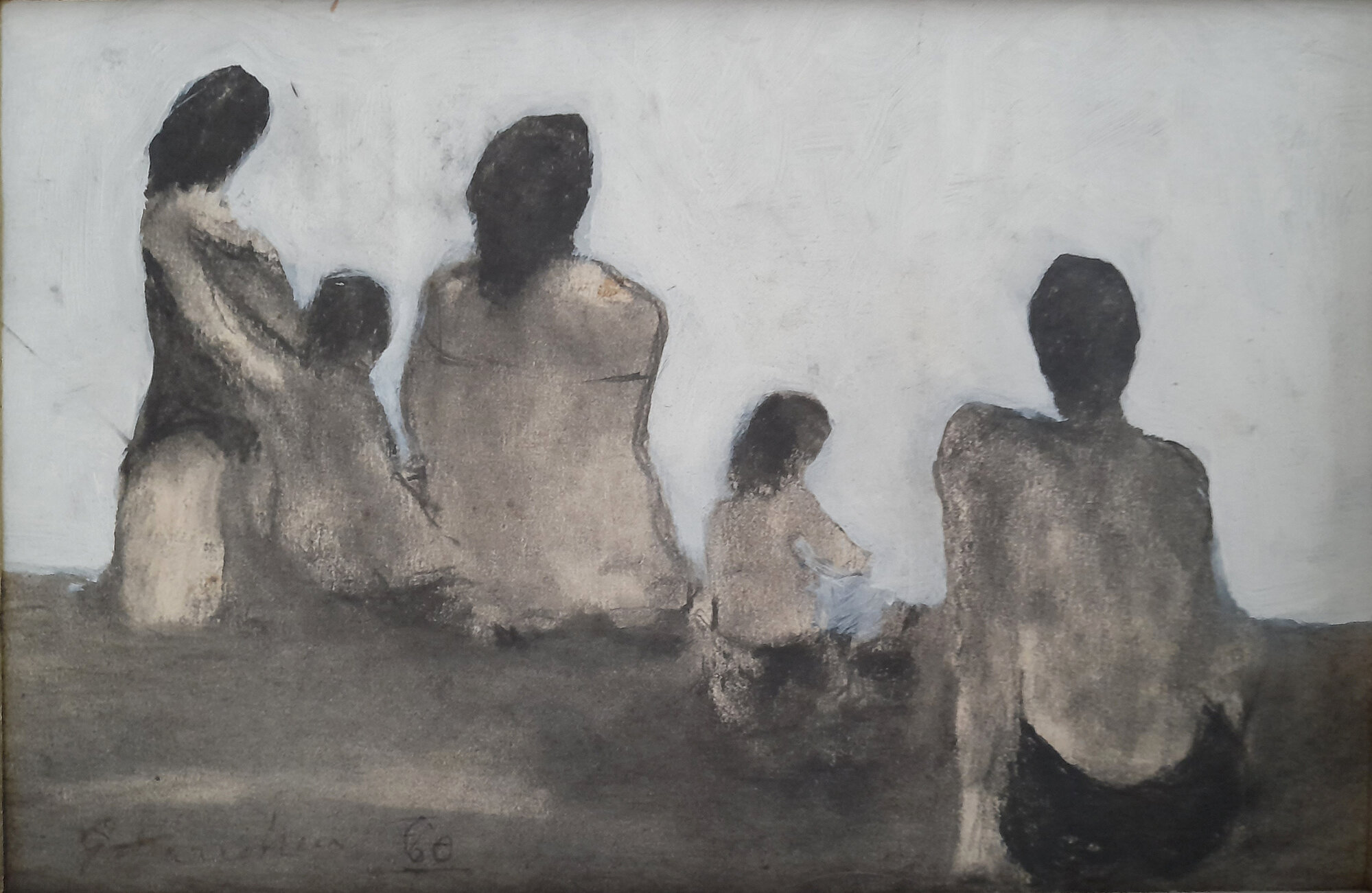
He was able to leave us very important signs of his human connection, in portraits such as “La Bruna” from 1960, which is a remarkable portrait of great power, and in certain landscapes where the nudes are headless like classical sculptures, ancient sculptures.
It has to do with the sense of a world that no longer has any fixed points of reference, where there are no longer any certain values, and everything—even families at the beach—is depicted from behind, as if to symbolize a state of unhappiness and inadequacy.
Indeed, among his most significant works is this misty landscape of a ghostly Cesena, which takes on the quality of a place in the afterlife.
His loyalty to his homeland, however, does not make him a vernacular artist who depicts Romagna as a picturesque scene, but rather as something imbued with the profound sense of a dramatic existence—which was his own—through the landscape themes so often discussed today.
Thus, the atmosphere—the pollution, the sense of the end of a certainty of a harmonious world—all of this is present in his intensely dramatic depiction, which still invites reflection today (he died in 1994) on a global crisis in which a profound unease is felt.
Then the faces, like that of this wonderful female figure, “La Bruna,” give us the sense that humanity endures, yet around us the world is crumbling; nature grows ever less joyful, and we must somehow try to defend ourselves by staying close, holding tight to one another, to avoid being swept away.
This hope, in the end, within his generally pessimistic vision, is a significant sign of the legacy that Gattavecchia leaves us through his painting."
Professor Vittorio Sgarbi